
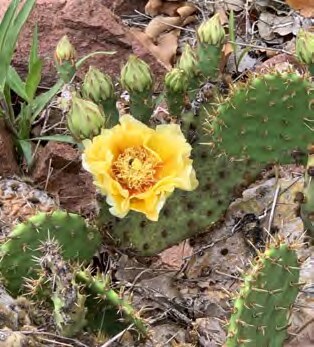
Plains Prickly Pear (Opuntia macrorhiza) has widely distributed populations from southern California to Ohio and Kentucky, but doesn’t quite reach the east coast. The Eastern Prickly Pear (Opuntia humifusa) takes care of that, as its area extends westward into the Plains Prickly Pear domain. Oklahoma has both species. To distinguish between the two, if the roots are thicker and more spines point down on pads, it is probably a Plains Prickly Pear.
The cacti world has its own terminology. Cacti have succulent stems (pads) with areoles (nodes) from which spines (modified leaves) and glochids (tiny modified hair-like barbed spines) emerge. All clear? In one to two years the jointed pads produce flashy yellow daytime flowers that last one to two days. But since the prickly pear is polymorphic, the pads, spines and flower colors may vary and not follow protocol. Good luck in figuring out what you are looking at without digging the cactus up. Those glochids are vicious, nearly invisible and barbed! Keep a pair of thick leather gloves handy.
The prickly pears growing along the roadside near my house have taken a hit from the extremes in weather, allowing opportunistic fungi to invade. Many of the pads have withered, turned black or died, but there’s hope. Some pads are still very much alive.
I rescued an Opuntia from the Phillips 66 Station in Chandler. After two years, new pads sprouted from the mother pad. Months later, one of the smaller pads was laying on the ground. The attached end was soft and mushy. The pad was dissected by the bluest caterpillars ever. The mush was caterpillar frass. The culprit was probably the Eastern Cactus Borer, one of the species of native prickly pear borer snout moths (Melitara sp.).
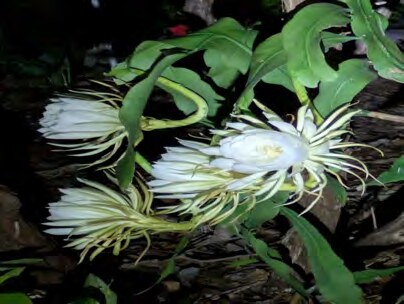
The Queen has yet to suffer such indignities. Cactus moths don’t target Epiphyllums. The Queen of the Night (Epiphyllum oxypetalum) is a Jungle Cactus, one of several tropical cacti, including the familiar Christmas Cactus (Schlumbergera bridgsii). All grow in tropical rainforests of Southern Mexico to the coasts of southeast Brazil. They have no wicked sharp spines as do the desert cacti. But the Queen attracts our native pollinators and has her own story to tell.
Queens of the Night reach ten to twenty feet in height in the tropics. My Queen is five feet tall, draped over a Juniper and living in a protected sun-dappled spot. Queen buds form as a genetic response triggered by changes in temperature and daylight. In the early summer the flowers will open only for one night and close before sunrise.
Flowers usually have sepals around the bud to protect it, but with Epiphyllum cacti such as the Queen of the Night, the sepals are light, designed like narrow petals and are called tepals. At midnight the bronze-colored outer tepals peeled back to expose pure white inner petals. After midnight, in the hot sultry stagnant air, all four flowers had opened in consecutive order from south to north. Each was beyond seven inches in diameter with a white star-shaped female stigma rising deep from the center, far above the hundreds of thin male stamens with anthers covered in yellow pollen. The intense fragrance was of sweet lemon verbena and honeysuckle with a musky afterthought that permeated the entire area.
If pollinating bats and moths couldn’t see the brilliant white blooms in the dark, the white petals reflect ultraviolet light and the flowers (to pollinators) would appear to glow. If the pollinators missed that, they should have been overwhelmed by the powerful floral aroma. Pollinators have very sensitive receptors on their antennae that guide them to their quests. Bees detect light, fruity odors, butterflies home in on strong sweet scents, flies go for the lovely rotting smell of death, but moths and bats are excited by heavy, intense fragrances. Pollinators can smell their targets over a half mile away!
Before sunrise the flowers were spent. An awesome display of nature. Next year I hope to see both sets of cacti in bloom. The Queen with her one-night only blooms and the Prickly Pears with their one to two day blooms. No blue caterpillars please.