
With the new year, the ONPN has selected five new plants to feature. The selected plants will be highlighted by growers in the network and grown in greater numbers to assure their availability. This year, the plants have been chosen to include:
- Grass: Switchgrass, Panicum virgatum
- Milkweed: Swamp Milkweed, Asclepias incarnata
- Woody: Clove Currant, Ribes odoratum
- Sun perennial: Prairie Blazing Star, Liatris pycnostachya
- Shade perennial: Woodland Phlox, Phlox divaricata
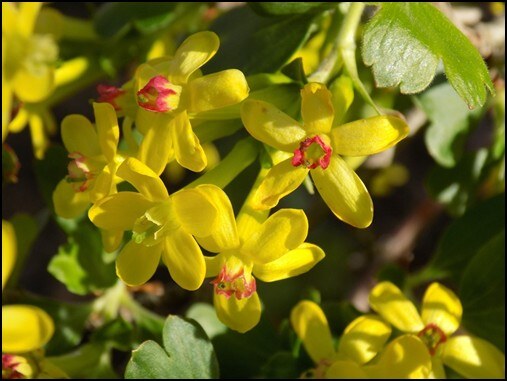
Clove currant, Ribes odoratum
Picture this: a short afternoon walk in a dappled wood or open glade. You’ve ventured out in earliest of spring. The sun is shining, a light breeze and suddenly you’re hit with an intoxicating fragrance. It’s much too early for any of the native trees to bloom, so what could it be? You track the fragrance to a shrub with attractive scalloped leaves and nestled in the ends of the branches are cute little yellow or yellow/red blooms about ¾” long by ½” wide. You’ve found the hardy little shrub named Ribes odoratum or clove currant.
This tough shrub tolerates a wide range of soil and moisture conditions: sandy, silty loam to clay. However, keep in mind that more shade reduces the number of blooms and fruit. Regardless of sun and moisture levels this native shrub will grow to be 6’–12’ tall by 6’–8’ wide. Few gardens have the room to accommodate a shrub this size, so plan to cut back by no more than one quarter the mass of the plant immediately after blooming. I recommend selectively pruning branches rather than shearing them to maintain the loose branching habit. This will also increase the number of blooms and fruit as those are formed on last year’s new, green wood.
The leaves on the new wood are alternate and are triple scalloped with a point on each lobe. They’re hairy underneath along the veins which are palm shaped. The late summer fruit can range from yellow to black. They’re edible right off the stem but can be made into preserves, jellies or pies. They’re small, about the size of your index fingernail or smaller (depending on rainfall as they mature) and full of seeds, so a bucket full won’t yield what you think it might. They can be frozen for later use.
These are hardy shrubs, from zone 4 south to zone 8 with a native range to the great plains. They will tolerate rabbit damage, drought and erosion. If planted in clay or silt soil, ensure that they are planted on a slope or berm. Don’t crowd the plants as they are susceptible to a few fungal diseases. There’s no appreciable impact from insects. They are attractive to hummingbirds, large bees and some butterflies. The fruit is attractive to many birds and small mammals. If you live in semi-rural areas you may get the occasional nibble by white-tailed deer.
The best planting season is fall to winter with early spring as a second planting season. Plan to water the first season and mulch with chopped leaves or commercial mulch to help retain moisture.