
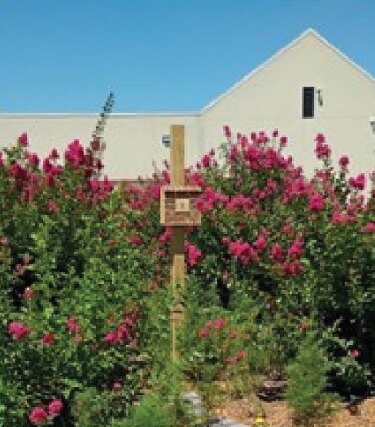
Welcoming all visitors is the goal of Catholic Charities of Eastern Oklahoma. Our plantings throughout the campus are designed to welcome all visitors – humans, pollinators, and birds. To accomplish this goal, the landscape team under the leadership of our volunteer, Cheryl Huber, relies on native plants to provide year-round visual aesthetic as well as to attract native (and non-native) pollinators.
The south side of campus features a registered Monarch Waystation. Milkweeds (Asclepias syriaca and A. tuberosa) are the foundational plants, although other plants, such as Joe Pye Weed (Eutrochium purpureum), provide a nectar buffet.
Also on the south side, along the administration wing, a long bed of black-eyed Susans (Rudbeckia missouriensis) provides a bright yellow visual interest for clients and staff who park in the adjacent lot.

This spring the landscape team installed a large pollinator garden which surrounds a prior planting of several crape myrtles in the middle of a grass lawn. Located on the north side of campus, it is seen by most of the persons who visit and utilize Catholic Charities’ services. The bed incorporates coneflowers (Echinacea purpurea) as well as blue mistflower (Conoclinium coelestinum) among others (we strewed a whole packet of Oklahoma native seeds into the bed!), with the goal of providing a continuous blooming period from spring through fall. The plantings are often covered in bees and butterflies as they savor the nectar, but the blue mistflower seems to be a magnet for butterflies and bees. In the midst of this pollinator patch is a native bee hotel mounted on a tall pole. The bed provides a teaching tool when school groups visit the campus. We use it to teach students about the various pollinators, about native bees and their nesting habits, how to maintain a bee hotel, and the importance of pollinators.
At each corner of the garden within the courtyard, we planted frog fruit (Phyla nodiflora) along with yarrow (Achillea millefolium) to lure bees and butterflies to pollinate our crops. We often see tiny native bees savoring the tiny flowers of the frog fruit. Butterflies also love the goldenrod (Solidago sp.) as well as more blue mistflower, both of which are incorporated in the many beds throughout the courtyard.
In short, we delight in the beauty, joy, and life that native plants bring to our campus; it is infectious: one volunteer recently followed a Monarch butterfly throughout the garden, in order to capture the best picture.
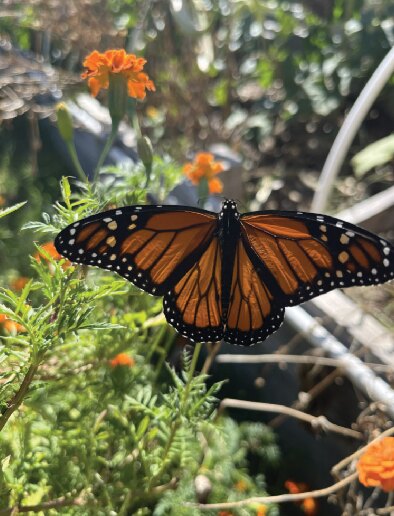
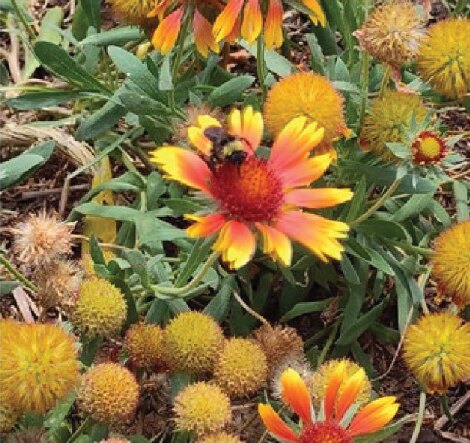
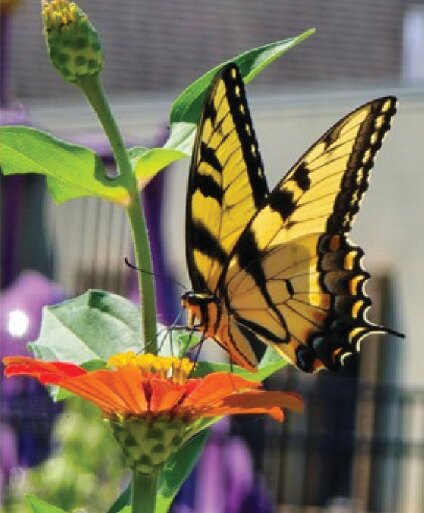
Monarch on marigolds; bumblebee on Gaillardia pulchella; and tiger swallowtail on zinnia.