
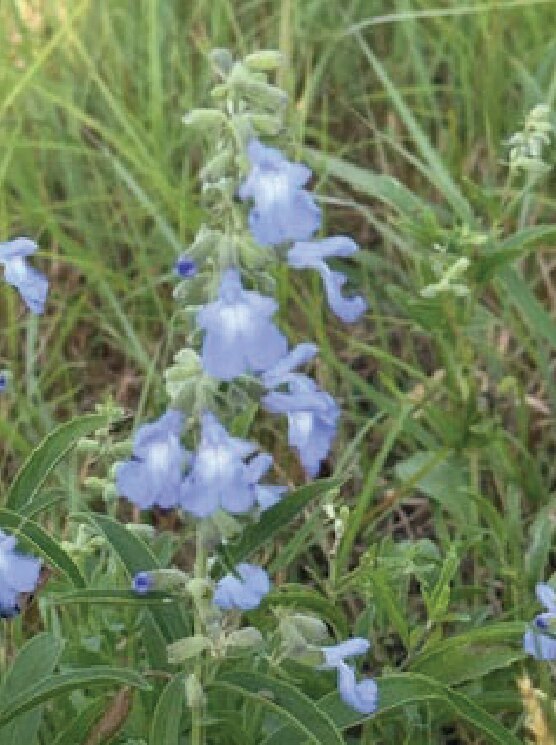
Pitcher Sage or Prairie Blue Sage, Salvia azurea
One of the first disappointments many gardeners face is realizing that most plants labeled “blue” are really just shades of purple pretending to be something they’re not. Before I became one of those people who can go on (and on) about native plants, Doug Tallamy, and the virtues of native bees, I fell hard for the Himalayan Blue Poppy in one of those glossy winter seed catalogs. It wasn’t the shape or even the name that hooked me—it was that impossible, electric blue.
Little did I know that one of the truest blues of all was quietly waiting in my own front yard, its seeds—or maybe roots—lying dormant until we stopped mowing.
That plant was Pitcher Sage or Prairie Blue Sage (Salvia azurea). For most of the summer it keeps a low profile, but by late August it sends up graceful spikes covered in sky-blue blooms that look like bits of daylight caught on a stem. Pitcher Sage thrives in full sun and well-drained soil, reaching about three feet tall. This salvia can be cut back in the middle of the growing season (before flowering) to keep it more compact for home gardens. It’s not aggressive or overly bushy, which makes it a good companion for other natives it can lean on—I especially like it paired with Summer Gaillardia (Gaillardia aestivalis) and Starry Rosinweed (Silphium asteriscus).
These true blue flowers are a welcome sight to many pollinators, including moths, butterflies, and bees (especially bumble bees). If you stand by a Prairie Sage plant for more than a few minutes in late summer through fall you are almost assured to see many of those rotund pollinators. The bumble bees charmingly try their best to cram their round bodies into the narrow throat of the beautiful blooms of Salvia azurea.
Pitcher Sage is one of the Oklahoma Native Plant Network’s highlighted species for 2025.
Most ONPN growers offer it as a plant, but it’s also easy to start from seed—no cold stratification required. Native across much of Oklahoma, it’s one of only four native Salvias in the state (the others are S. lyrata, S. farinacea, and S. reflexa).
This perennial native prairie sage can be a majestic and tall addition to home landscapes. Its strikingly blue flowers add a pop of color in summer (yellow, yellow, yellow, BLUE!!!! yellow, yellow, yellow) and its unique bilaterally symmetrical flowers draw the eye of both humans and pollinators.